
Bull Market vs Bear Market: 5 Best Things to Know
Somebody on a call or in the news says we're officially in a bear market, and five minutes later a different headline says stocks are back in a bull market. If you've ever paused mid-scroll wondering what the real bull market vs bear market difference actually is, you're already asking the right question. The same goes for wondering whether you're supposed to be doing something about it right now.
Quick Answer: A bull market is a stretch of time when stock prices are generally rising. A bear market is a stretch of time when stock prices are generally falling, usually measured as a drop of 20% or more from a recent high. Neither label tells you to make a sudden move with your own money. Both are normal, recurring parts of investing, not a sign that something has gone wrong, and not something you were supposed to already know.
What a Bull Market vs Bear Market Actually Means
A bull market vs bear market comparison comes down to direction and duration, not a single bad day or a single good one. According to the Financial Industry Regulatory Authority (FINRA), a bear market is generally defined as a decline of 20% or more in a broad market index. The term is used in contrast with a bull market, which refers to a large, sustained increase in prices.
Notice what that definition does not say. It does not say which specific stock, fund, or account you own. It does not say how long the phase will last. It is describing the overall mood and direction of the broad market. Think of it the way a weather report describes a season, not any single day. A bull market vs bear market label is a description of a pattern over time, not a prediction and not advice about what you personally should do next.
Where the Bull and Bear Names Come From
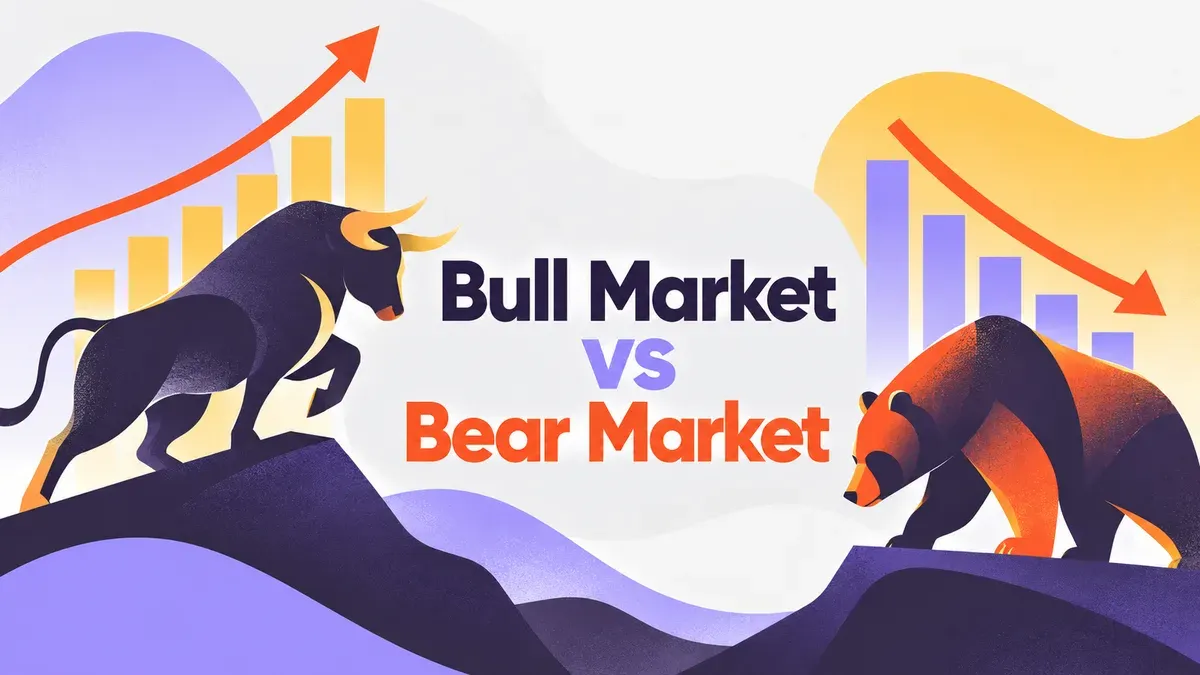
The names themselves are just memory tricks, not technical terms you need to overthink. A bull attacks by thrusting its horns upward. That's why a rising market is called a bull market. A bear attacks by swiping its paws downward. That's why a falling market earned the bear market name. That's the whole trick. If you can picture the direction of the swipe, you already know which one is which. You never have to feel behind for forgetting it again.
Why the Market Moves Between These Two Phases
Markets shift between a bull market vs bear market pattern for a mix of real, documented reasons, not random noise. Company earnings grow or shrink. Interest rates rise or fall. That changes how expensive it is for businesses and consumers to borrow. Employment and consumer spending strengthen or weaken. Investor confidence feeds on itself in both directions. Optimism attracts more buying, and worry attracts more selling.
None of those forces move in a straight line forever. A strong economy eventually runs into higher prices, higher borrowing costs, or an unexpected shock. Buying slows down. A weak economy eventually works through its problems. Prices adjust, and buying picks back up. That back-and-forth is the actual engine behind every bull market vs bear market cycle that has ever happened. It is a real, ongoing process, not a glitch in the system.
Interest rates play a bigger role in this than most people realize at first. When the Federal Reserve raises rates, borrowing money gets more expensive for businesses and consumers alike. That tends to slow down spending and can cool off a bull market. When the Federal Reserve lowers rates, borrowing gets cheaper. Spending tends to pick back up, and that can help pull a bear market back toward growth. Neither move happens overnight, and neither one flips a bull market vs bear market label by itself. It's one input among several, not a single switch.
A Bull Market vs Bear Market Label Covers the Whole Market, Not One Sector
Here's a distinction that trips people up once they start paying closer attention to the news. The bull market vs bear market label describes a broad index, like the S&P 500, as a whole. It does not mean every single sector inside that index is moving the same direction at the same time.
During an overall bull market, some sectors can still lag behind or even lose value. Others pull far ahead of the pack. During an overall bear market, a handful of sectors can still hold up reasonably well, even while the broader index drags the overall average down. That's a completely different concept from the bull market vs bear market cycle itself. What is sector rotation investing covers it in full, if you want to go deeper on how individual sectors move in and out of favor within whichever broader phase we happen to be in.
A Short Down Week Isn't the Same As a Bear Market
One of the most common mix-ups is treating a single rough week like proof that a bear market has started. It hasn't. This is worth repeating, because it is the exact point where a lot of people start making decisions out of fear instead of information.
During a real Monday Market Live session with the WealthMore community, the market had just closed out a down week across every major benchmark. The guidance given on that call stayed simple and durable. Short, temporary dips are expected. They are not the same signal as a real bear market. A single down week, or even a down month, does not automatically flip the label. What matters is the broader, sustained direction over time, not any one loud afternoon or one rough Friday.
This is also why checking your own numbers constantly during a rough stretch tends to backfire. If you've noticed yourself doing this, why the stock market can feel scary even when nothing is actually wrong with your plan is worth reading next. It walks through exactly why headlines spike anxiety faster than your actual account changes.
The Real Bull Market vs Bear Market Question Erika Answers on Monday Market Live
This exact topic came up directly during a Monday Market Live session, when a member asked how to trade during a bear market. The answer, kept general and educational rather than a specific recommendation, was this: people find ways to participate in the market during both phases, not just during a bull market. Some investors use strategies built specifically for falling prices, including short selling and options contracts called puts. Both are designed to make money when a price drops rather than rises.
Those strategies were named honestly, not minimized and not encouraged. They were also flagged as advanced and genuinely risky. That risk goes beyond simply holding an investment and riding out a downturn. That's a fair, complete answer, and it's also exactly where this guide draws its own line. You'll find the full boundary spelled out later in the "What This Guide Doesn't Cover" section below.
What matters for most WealthMore members isn't learning a new trading technique mid-downturn. It's understanding that a bull market vs bear market swing is a known, documented part of investing, something people have been navigating for as long as markets have existed, not a personal emergency that requires an immediate, complicated reaction.
What a Bull Market vs Bear Market Shift Means for Your Own Numbers
Here's where this connects to your actual account instead of just the news. WealthMore ties the three major benchmarks, the S&P 500, the Dow, and the NASDAQ, to a personal risk score. That gives you something concrete to measure your own portfolio against, instead of just reacting to a headline. If you've never checked yours, how to check your investment risk score walks through exactly how to find that number inside the Provenance app.
Once you know your number, the benchmark comparison gets specific and useful. What does the S&P 500 measure breaks down how each of the three benchmarks lines up with a different risk score range. During a bull market vs bear market swing, that lets you check your own portfolio against the benchmark that actually matches how much risk you're comfortable taking. You're no longer comparing yourself to a number that was never meant for your situation in the first place.
That one habit, checking your own number against your own matching benchmark, does more for your actual confidence during a downturn than trying to guess when the next shift is coming.
The Bear Market Mistake That Costs More Than the Downturn Itself
Here is the part worth sitting with. The drop itself is rarely what does the most damage to a long-term plan. The damage usually comes from the reaction to the drop, specifically from selling everything out of fear near the bottom and then missing the recovery that follows.
A downturn only becomes a permanent loss once you sell. Before that point, it's a number on a screen that can still recover over time, the same way it has after every past bear market phase. Selling in a panic turns a temporary dip into a locked-in loss. It also means you're not in the market for the bounce back. That bounce historically tends to happen while confidence is still low, while most people are too nervous to buy back in.
This doesn't mean every holding deserves to be kept forever no matter what. When to sell a long-term stock walks through the real, specific signs that justify a sale, like a company's situation genuinely changing or your own goals shifting. That's a completely different decision than selling everything purely because the overall market is down.
What Actually Helps When You're Not Sure Which Phase We're In
You don't need to correctly label every bull market vs bear market shift in real time to invest well. A few steady habits matter far more than getting the label right on any given day.
- Separate your long-term money from your short-term money, ideally in different accounts, so a downturn in one doesn't make you touch money you'll need soon.
- Check your own portfolio's performance against your own matching benchmark on a set schedule, not every time a headline spikes your anxiety.
- Keep contributing on a regular schedule if that's part of your plan, since buying consistently through both phases tends to smooth out the highs and lows over time.
- Remind yourself that a falling index is describing the broad market's mood, not personally grading your financial decisions.
- Bring your specific question to a real person instead of guessing alone, especially the first time you're sitting through an actual downturn.
- Write down your own plan while things feel calm, so you have something steady to return to once a real bull market vs bear market swing actually arrives and emotions are running higher.
According to FINRA's own guidance on market swings, buy-and-hold investors who invest for the long term tend to treat volatility like background noise rather than a signal to act on every swing. That's not a casual opinion. It's a documented pattern among investors who stay in the market long enough to ride out a full bull market vs bear market cycle instead of jumping in and out of it.
What This Guide Doesn't Cover, and Why
In the spirit of full honesty, here is exactly what this guide will not tell you. It will not tell you whether we're currently heading into a bull market or a bear market. That would be a market prediction, and no one, including WealthMore, can know that in advance. It will not tell you to buy, sell, or hold any specific stock, fund, or ETF. That would be personalized financial advice, not general education. It will not walk you through how to actually execute a short sale or a put option either. Those are advanced, high-risk strategies that deserve real instruction from a licensed professional, not a single paragraph in a blog post.
What it will do is help you understand the difference between the two phases well enough that the next headline doesn't send you into a decision you'll regret. That's the actual, honest goal here, and it's a realistic one.
If you're genuinely considering a more advanced, higher-risk strategy for a bear market, the right move is a real conversation with a licensed financial professional. They can look at your full, specific situation. This article can't, since it's written for a wide audience. The same goes for any question about your own tax situation or a legal document like a will or trust. Those are personal, specific answers that deserve a personal, specific conversation, not a one-size-fits-all paragraph.
You're Not Behind for Just Now Learning This
If you grew up without anyone walking you through what a bull market vs bear market swing actually means, you're not behind. You just never had the person in the room explaining it in plain language. That's a big part of why WealthMore exists in the first place. First generation wealth building covers the fuller story of why this kind of plain-language financial education became the whole point of the community, if you want the longer version.
Markets have always moved in cycles. Every single person currently comfortable with these terms once heard them for the first time too. Learning the real difference now, instead of nodding along while feeling confused, is the actual step that moves you forward.
Frequently Asked Questions
Does a bear market mean I should sell everything?
Not automatically, and selling everything purely because the broad market dropped is one of the most common ways a temporary paper loss turns into a permanent one. A real decision to sell should come from your own specific goals or a genuine change in what you're holding, not from the index itself falling. If you're unsure, that's a real question worth bringing to a professional rather than guessing alone.
How do I know whether we're in a bull market vs bear market right now?
Check a broad index like the S&P 500 against where it stood at its most recent high. A sustained drop of 20% or more generally marks a bear market, while a sustained rise marks a bull market. A single down day or down week doesn't flip the label on its own, since both phases are measured over a longer stretch of time, not a single session.
Is a market correction the same thing as a bear market?
No, and this is a genuinely common mix-up. A correction is typically a shorter, smaller pullback, usually in the range of 10%, that can happen inside either a bull market or a bear market without necessarily signaling a full phase change. A bear market is the deeper, more sustained 20%-plus decline. Corrections happen far more often than full bear markets do.
I still have a specific question. Who do I actually ask?
Show up to a live Monday Market Commentary session and put your hand up. One member gets to ask a genuine personal-finance question on every call, and it's answered right there, in plain words, as general education rather than a canned script. Nobody on that call is going to make you feel small for not already knowing this. Most of the room is learning it alongside you.
Ready to actually sit in on one of these calls instead of just reading about them secondhand? Join the Weekly Market Commentary: Live and Free and bring your own bull market vs bear market question to the next session.