
Stock Market Correction vs Crash: 5 Best Things to Know
Quick answer: A stock market correction vs a crash comes down to two things: how far prices fall, and how fast. FINRA defines a correction as a drop of 10% or more from a recent high, and a bear market as a drop of 20% or more.
A crash has no official percentage attached to it at all. What actually separates a correction vs a crash is speed, not size: a crash is a fast, panicked drop that happens in days, while a correction can stretch across weeks or months. Knowing the real difference will not tell you what to do with your own money, but it will stop a scary headline from automatically meaning more than it actually does.
What a Stock Market Correction vs a Crash Actually Means
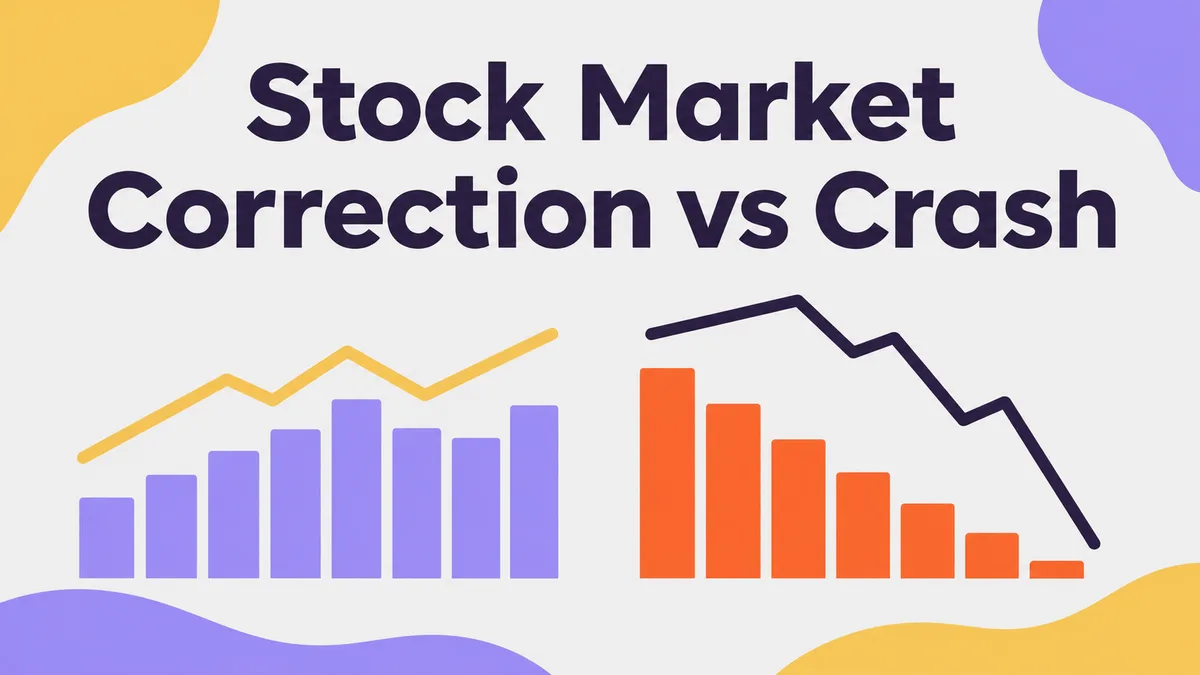
The words "correction," "crash," and "bear market" get used like they all mean the same thing. They do not. A correction vs a crash is really a question about two separate measurements: how big the drop is, and how long it takes to happen.
FINRA's own glossary of market vocabulary defines a correction as when stocks, bonds, or a broad index "reverse course by at least 10 percent" from a recent high. The same page defines a bear market as a decline of 20 percent or more. Those two numbers, 10 percent and 20 percent, are the real dividing lines most finance professionals actually use when they say one of these words out loud.
A crash works differently. There is no official percentage that turns a decline into a crash instead of a correction. What actually separates a correction vs a crash is speed, not size. A correction can take weeks or months to fully play out. A crash happens in a matter of days, sometimes hours, and it usually arrives with a very specific kind of panic attached to it that a slower correction rarely has.
How a Correction vs a Crash Actually Feels While It Is Happening
A correction usually feels like a long, uneven slide. Prices drop for a while, bounce back a little, drop again, and the whole stretch can take weeks to add up to that 10 percent mark. Because it moves slowly, a correction rarely dominates every single headline for days in a row. It shows up, gets mentioned, and then competes with other news.
A crash feels completely different while it is happening. The drop is sharp enough, and fast enough, that it becomes the only story in the news for days at a time. There is a reason crash headlines feel more frightening than correction headlines. They usually are describing something that is genuinely moving faster, not just something that sounds worse.
This is worth sitting with for a second: your gut reaction to a correction vs a crash is not irrational. A fast, steep drop really does carry a different kind of real-time stress than a slow one, even when the eventual size of the two drops ends up similar. Your nervous system is responding to speed, and speed is a real variable here, not just a feeling.
The 1929 Crash Shows the Real Difference in Actual Numbers
History offers one clean, well documented example of what a true crash looks like, and it helps make the correction vs crash difference concrete instead of abstract. This is a single historical case, not a prediction about anything happening now or next.
According to the Federal Reserve's own history project, the Dow Jones Industrial Average fell nearly 13 percent on October 28, 1929, a single day now known as Black Monday. The very next day, Black Tuesday, it fell nearly 12 percent again. By mid-November, roughly half the market's value from before the crash was already gone. That is the speed that defines a crash: two days wiped out what would take a typical correction weeks to approach.
The size kept growing from there. The market did not finally bottom out until the summer of 1932, roughly 89 percent below its 1929 peak. The Dow did not fully return to its pre-crash high again until November 1954. That is a 25-year round trip. No part of that timeline is a forecast for the future. It is simply the real record of the most extreme example in modern market history, offered here as context, not as a warning about what is coming next.
Bear Market Is the Word That Sits Right Next to Both
A bear market shares its 20 percent threshold with the deep end of what people informally call a crash, which is exactly why the two words get tangled up in conversation. The real difference is what each word is measuring. A bear market describes a sustained stretch of falling prices and pessimistic sentiment, often lasting many months. A crash describes a specific, fast event, often the opening chapter of a bear market rather than the whole thing.
WealthMore's own breakdown of bull markets vs bear markets covers that 20 percent threshold and the sentiment side of the bear market definition in more depth, so this post will not repeat that walkthrough here. The short version worth keeping: a bear market is a season, a crash is a single stormy afternoon that can happen inside that season. A correction, by contrast, does not have to turn into either one. Plenty of 10 percent corrections bottom out, recover, and never reach the 20 percent mark that would make them a bear market at all.
Why the News Uses Scary Words for Both, Even When Only One Applies
Financial headlines reach for dramatic language because dramatic language gets read, not because every drop actually deserves it. A 10 percent correction and a 20 percent crash can both get described with words like "plunge," "tumble," or "sell-off," even though only one of them is moving at crash speed.
WealthMore's post on why the stock market feels scary already walks through exactly how that happens, down-day coverage bias and all, so this post will not rebuild that explanation from scratch. What matters here is narrower: once you know the real correction vs crash thresholds, you can read a scary word and immediately ask the one question that actually tells you something, which is simply how big and how fast the move really was.
What This Correction vs Crash Breakdown Does Not Cover, and Why
This explainer is not telling you whether the market is currently in a correction, a crash, or neither. It is not a signal to buy, sell, or hold anything in your own account, and it is not a forecast of what happens next in any market. None of that would be true for every single reader at once, so none of it belongs here.
It also will not tell you how to time a decision around a correction vs a crash. WealthMore's own post on whether it is smart to try to time the market covers why trying to guess the bottom of a drop, correction or crash, is a different and much harder problem than simply understanding what the words mean. What this post does cover is the plain, historical, educational difference between the terms, nothing more.
What Actually Helps When You Hear Either Word
Understanding the correction vs crash difference will not stop the next scary headline from showing up. It can change how you respond to it. A few habits make that response steadier.
- Check the actual number before reacting to the word. A 4 percent dip described as a "plunge" is not the same event as a real 20 percent crash, even if the headline language sounds similar.
- Remember that corrections are a normal, recurring part of investing, not a sign that something has gone wrong with your plan.
- Give yourself a pause before making any account change based on a single day's news. A short delay rarely costs you anything, and it keeps a fast emotional reaction from becoming a fast financial one.
- Read WealthMore's guide on staying calm during market volatility for the fuller set of steps, since that post covers the real-time habit side of this in more depth than fits here.
- Bring the specific headline to a judgment-free space instead of sitting with the worry alone. Saying a fear out loud, to someone who will not make you feel behind for asking, usually shrinks it.
None of this requires becoming a market historian. It just means treating the word itself as a clue worth checking, not as an automatic verdict on your own money.
Why Your Own Number Matters More Than the Word
A correction vs a crash is a description of the whole market, not a description of your own account. The S&P 500 falling 12 percent does not automatically mean your own portfolio fell exactly 12 percent too. It depends on what you actually hold, how it is spread across different kinds of investments, and how much of it was already in cash or bonds before the drop even started.
This is part of why checking your own real number matters more than reacting to whichever word a headline uses that week. WealthMore's guide on checking your investment risk score walks through how to find that number for your own account, so a scary word like "correction" or "crash" can be measured against your actual plan instead of against a mood in the news.
Once you know your own number, a correction vs crash headline becomes a prompt to go check something real, rather than a reason to feel a vague sense of dread about money in general. That one small shift, from reacting to the word to checking your own account, is most of what separates feeling blindsided by market vocabulary from feeling like you actually understand what is being described.
A Quick Gut-Check Before You React to Either Word
The next time a headline uses "correction," "crash," or "bear market," run through these four questions before you do anything else with your own account.
- How big was the actual drop, in percentage terms, not just in the tone of the headline.
- How many days or weeks did that drop take to happen.
- Is this being described as a single event, or as part of a longer stretch of falling prices.
- Does anything about my own plan actually depend on what happens in the next single day.
Most of the time, the honest answer to that fourth question is no. A long-term plan was already built with ordinary ups and downs in mind, correction-sized or otherwise.
Why Someone Who Has Taught This for a Decade Still Keeps It Simple
ErikaBlair McGrew has spent more than ten years teaching financial identity, working directly with over 100 institutions, students, and donors along the way, long before WealthMore existed. Across that decade she has watched real corrections come and go, and she has lived through the kind of real, fast drop that actually earns the word crash. That is exactly why she still reaches for the plain, two-question version of this explanation instead of a more complicated one: size and speed, nothing fancier.
One WealthMore member put it this way: "I used to feel so behind. Now I help my niece open her first account." That is the real goal behind a post like this one. Knowing the difference between a correction and a crash is not about sounding like a finance expert. It is about having enough plain-language footing that you could explain the words to someone else, the way that member now does for her own niece, instead of freezing every time a headline uses one of them. For the fuller story of how ErikaBlair got from a Wall Street office to a free weekly class, WealthMore's first generation wealth building post covers that in full.
You Do Not Have to Memorize These Words to Be Okay
School rarely covers the difference between a correction and a crash, so most people pick up all three words, correction, crash, and bear market, as one blurry category meaning "something bad happened with money." Nobody ever walked you through the actual thresholds growing up, which is exactly why a headline can still catch you off guard even after reading an explainer like this one.
That is part of why WealthMore runs its Monday Market Commentary every week, free, with a live question from an actual member worked into each session instead of a fixed script. Over 500 first-generation wealth builders already attend, and a fair number of them are hearing a breakdown like this correction vs crash one out loud for the first time, on whichever week it finally clicks.
Frequently Asked Questions
What percentage drop counts as a stock market correction?
A decline of at least 10 percent from a recent high, according to FINRA's own definition. That threshold is the one most finance professionals actually use when they say the word out loud.
What percentage drop counts as a crash?
There is no official percentage. A crash is defined mainly by speed, a sharp, fast decline that happens over days rather than weeks or months, more than by hitting any specific number.
Is a bear market the same thing as a crash?
No. A bear market describes a sustained stretch of falling prices and pessimistic sentiment, often lasting many months, and it shares the 20 percent threshold with the deep end of a crash. A crash is a specific, fast event that can happen at the start of a bear market, not the whole season itself.
How long does it usually take to recover from a correction vs a crash?
A correction tends to resolve faster than a crash simply because it started smaller and moved slower. A crash, especially a severe one like 1929, can take years, and in that specific historical case decades, to fully recover its prior high. Neither timeline is a promise about any future event. A correction has more room to recover quickly simply because the hole it has to climb out of is shallower, while a true crash has to climb out of a much deeper one, and that extra depth is the real reason the clock runs so much longer.
Does hearing the word "crash" mean I should sell everything?
Not on its own. This post is general education about what the word means, not a signal about what to do with your own account. A real decision about your own money depends on your own situation, which is outside what any single explainer can responsibly cover.
I still mix these words up sometimes. Is there somewhere I can ask about my own confusion?
Yes. WealthMore's Monday Market Commentary sets aside time in each session for one actual member question, answered live and in plain language, as general education rather than a canned script. Mixing up correction, crash, and bear market is common, not a sign you missed something you were supposed to already know.
A Calmer Way to Hear Either Word
You do not have to become a market historian to tell a correction vs a crash apart. Knowing the two real dividing lines, 10 percent and 20 percent, plus the speed each word is actually describing, covers most of what a scary headline is trying to tell you.
Join WealthMore's Monday Market Commentary to hear vocabulary like this unpacked live, out loud, in plain language, without any rush to react to whatever that particular week's headline happens to say.
Join the Weekly Market Commentary: Live and Free. Save your spot →